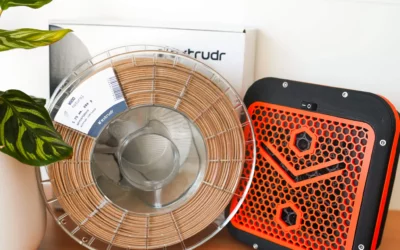
TPU (Thermoplastic Polyurethane) is a flexible and durable material widely used in 3D printing, but how safe is it to print indoors? Unlike ABS or ASA, which require high temperatures and are known for releasing strong odors and potentially harmful fumes, TPU prints at a much lower temperature. It also requires significantly slower print speeds compared to PLA.
But the real question is: if you print TPU in a closed space like your office or bedroom, will it release harmful fumes, or is it as safe as PLA or PETG? In this article, we’ll explore TPU’s emissions, compare them to other materials, and discuss whether you need ventilation when printing with it.

Every single filament releases VOCs (Volatile Organic Compounds) and ultrafine particles (UFPs), even PLA, TPU, and PETG. Just because ABS has a strong smell doesn’t mean it’s necessarily more harmful than odorless filaments.
While ABS and ASA are known for higher emissions, TPU also releases VOCs and UFPs—just in different amounts and compositions. The key concern isn’t just the smell but the actual particles and chemicals in the air.
According to the research titled “Exposure hazards of particles and volatile organic compounds emitted from material extrusion 3D printing: Consolidation of chamber study data” by Qian Zhang and Marilyn S. Black (published in Environment International, 2023), they found that TPU (thermoplastic polyurethane) filament emits both ultrafine particles (UFPs) and volatile organic compounds (VOCs) during 3D printing

2. Specific VOCs detected in TPU Emissions
- The study identified cyclic methyl siloxanes (D4, D6, D7, D8) as some of the most emitted VOCs from TPU.
- Tetrahydrofuran (THF), which can be used in TPU synthesis, was also detected. THF is classified as a possible carcinogen by some regulatory agencies.
- Other VOCs commonly found in TPU emissions included aldehydes, alcohols, and ketones, some of which are known irritants.
3. Health Risks
- TPU emissions include chemicals that may cause respiratory irritation, headaches, and dizziness in poorly ventilated environments.
- Exposure to certain siloxanes and THF can have long-term toxic effects, potentially impacting the liver and nervous system.
- Indoor exposure modeling showed that TPU emissions did not exceed major air quality limits but still contributed to indoor air pollution.
4. Exposure Recommendations
- Proper ventilation is advised when printing with TPU to reduce exposure to VOCs.
- HEPA + activated carbon filtration can help mitigate toxic emissions.

II. Safety First: Why you shouldn’t use an FDM 3D printer in a bedroom
Even though TPU and PLA are considered some of the least toxic 3D printing filaments, they still release ultrafine particles (UFPs) and volatile organic compounds (VOCs). These emissions can contribute to indoor air pollution, which is especially concerning for children. Children’s lungs are smaller and more sensitive to pollutants, making them more vulnerable to respiratory issues.
Key Safety Tips
✅ Never place a 3D printer in a bedroom unless you have an enclosure vented outside with an exhaust fan.
✅ Don’t run the printer overnight, especially if a child is sleeping in the same room.
✅ Install a smoke alarm and keep a fire extinguisher nearby—printers are electrical devices, and malfunctions can happen.
✅ Monitor your printer while in use to reduce risks of overheating or other hazards.
III. Conclusion
TPU (Thermoplastic Polyurethane) is generally considered safer than ABS in terms of fumes, but it can still release volatile organic compounds (VOCs) when heated. The fumes from TPU are typically less harsh and have a milder odor compared to ABS, which can produce stronger, more irritating fumes, especially when printed at higher temperatures.
TPU emits fewer ultrafine particles, but it’s still a good idea to have ventilation or a filtration system in place when printing with any material, including TPU, to ensure a safe printing environment. If you must use a 3D printer indoors, prioritize proper ventilation and air filtration to minimize exposure to harmful particles. Your health—and your family’s health—comes first!

Reference
Zhang, Q., & Black, M. S. (2023). Exposure hazards of particles and volatile organic compounds emitted from material extrusion 3D printing: Consolidation of chamber study data. Environment International, 182, 108316.