When it comes to 3D printing, emissions are often misunderstood or underestimated, especially by hobbyists, educators, and even some manufacturers. From ultrafine particles (UFPs) to volatile organic compounds (VOCs), the air around your printer can become a source of hidden health risks if not properly managed.
In this article, we break down the top misconceptions about 3D printing emissions, and explain what truly matters when it comes to filters, sensors, and air quality.
🔴 Misunderstanding: Many users believe that the presence of a HEPA filter automatically ensures full protection during 3D printing.
🟢Reality:
Simply having a HEPA filter is not enough. Several key factors affect filtration performance:
- Filter Size: Some printers include very small HEPA filters that are undersized for the build volume. A tiny filter in a large enclosure can’t effectively clean the air.
- Filter Mass (g of media): Some filters look big, but are mostly empty inside or use thin pleats, reducing filtration surface area and lifespan.
- Filter Type: Many filters for 3D printing are rated E12. We recommend using filters that are at least HEPA13, with HEPA14 being the best option, offering significantly better efficiency—up to 99.995% of 0.3 μm particles.
- No VOC Filtration: Even a perfect HEPA filter won’t stop gaseous emissions like VOCs. Activated carbon is needed to adsorb odors and chemicals.
➡️ Effective protection means:
- Right-sized HEPA14 filter
- Sufficient media mass (not just housing size)
- Combination with activated carbon
- Good airflow design to ensure all emissions pass through the filter

Bambu Lab activated carbon filter
II. My air quality sensor shows safe levels, so I’m fine
🔴 Misunderstanding: Many users rely on cheap or DIY air quality monitors to assess safety. However, these often lack true VOC sensors—PID sensors cost $500+, while cheaper ones use unreliable semiconductor sensors. They show trends, but not accurate data.
And in terms of marketing, many brands often talk about PM₂.₅ (particles smaller than 2.5 µm), but in many contexts—like 3D printing—what matters more are ultrafine particles (UFPs) or nanoparticles (<100-200 nm, sometimes <10 nm), because they behave quite differently in terms of health risk. Below I unpack the differences, what the science says about UFPs in 3D printing, and why PM2.5 alone is insufficient (or even misleading) as a safety metric.

Credit: Creality
🔴 Misunderstanding: Many users rely on cheap or DIY air quality monitors to assess safety. However, these often lack true VOC sensors—PID sensors cost $500+, while cheaper ones use unreliable semiconductor sensors. They show trends, but not accurate data.
And in terms of marketing, many brands often talk about PM₂.₅ (particles smaller than 2.5 µm), but in many contexts—like 3D printing—what matters more are ultrafine particles (UFPs) or nanoparticles (<100-200 nm, sometimes <10 nm), because they behave quite differently in terms of health risk. Below I unpack the differences, what the science says about UFPs in 3D printing, and why PM2.5 alone is insufficient (or even misleading) as a safety metric.
🟢Reality: Most low-cost monitors can’t detect ultrafine particles (<200 nm), the 3D printer nanoparticles emitted are 10 to 100 nm. VOC readings are often vague, estimated, or simply inaccurate.

3D Printer Emissions Sensor Array by MadeWithLayers
III. Air purifiers work just fine for resin and filament printing
🔴Misunderstanding: People often use off-the-shelf air purifiers to reduce exposure during 3D printing.
🟢Reality: Most home air purifiers are not designed to handle the specific particle size and chemical complexity of 3D printing emissions, especially for resins, which release toxic.
➡️ Resin printing should be done in sealed, ventilated enclosures with appropriate filtration systems.

Source: Internet
IV. VOCs are the main risk in 3D printing filament
🔴 Misunderstanding: Many users believe that VOCs are the primary health risk when using FDM 3D printers.
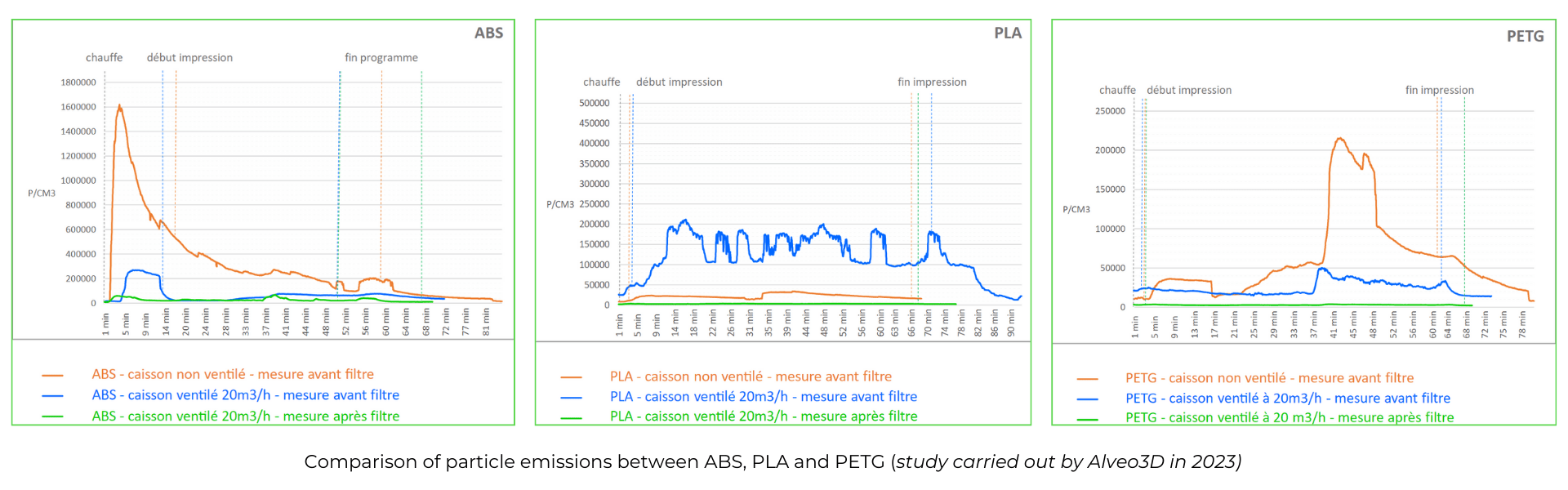
🟢Reality: VOCs are not the main threat in 3d printing FDM. According to our studies, VOCs typically account for less than 10% of the total health risk from 3D printing emissions filament. The major risk comes from ultrafine particles (UFPs) , tiny particles (often <100 nanometers) that are emitted in very high quantities during filament printing. However, when it comes to resin printing, VOCs are definitely the biggest problem.
➡️ UFPs can penetrate deep into the lungs, pass into the bloodstream, and contribute to respiratory and cardiovascular issues.
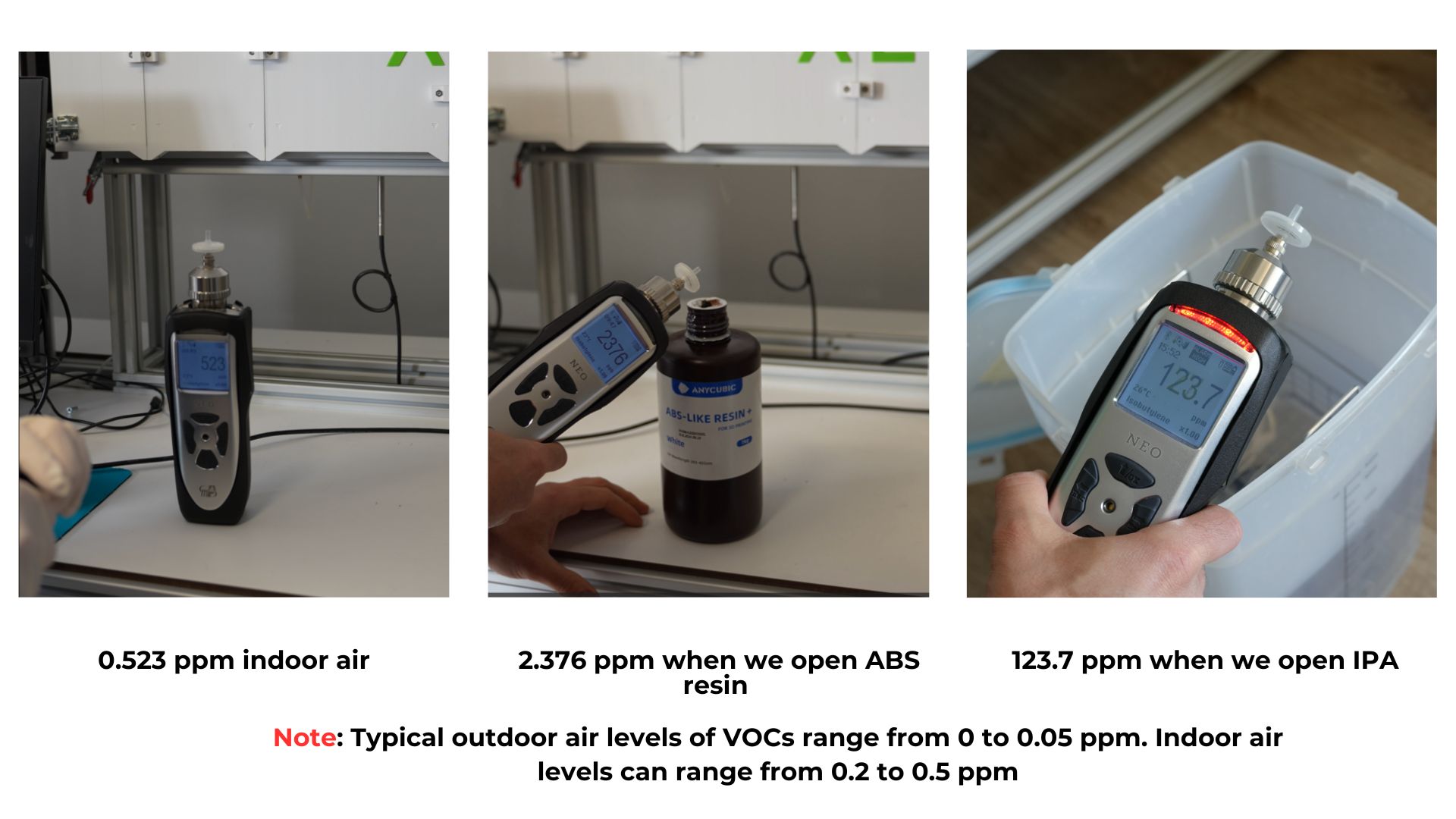
➡️ VOCs can still cause irritation or discomfort (especially with ABS, ASA, and resins), but their toxicity levels rarely exceed thresholds in home/office environments, unless ventilation is very poor.
Bottom line: Don’t ignore VOCs, but prioritize protection against UFPs with a high-efficiency HEPA14 filter, and combine it with activated carbon for complete coverage.
V. If I don’t smell it, It’s not dangerous
🔴 Misunderstanding: Many users believe that if there’s no strong odor while printing, the emissions must be safe. Some manufacturers even promote “low-odor” or “odorless” resins and filaments as if they are risk-free.
🟢Reality: This is misleading and potentially dangerous. Odor is not a reliable indicator of air quality or safety. Many harmful substances released during 3D printing , especially ultrafine particles (UFPs) and certain VOCs are completely odorless.
VI. PLA is safe, so there’s no risk
🔴 Misunderstanding: Many users believe that printing with PLA (a bioplastic) is completely harmless
🟢 Reality: While PLA emits fewer ultrafine particles (UFPs) and VOCs than ABS or ASA, it still emits particles that may irritate the respiratory system, especially in poorly ventilated areas or with prolonged exposure.
While many influencers on YouTube attempt to explain 3D printing emissions, most of their information is often inaccurate. It’s crucial to rely on scientific studies from reputable labs like CNRS in France, which provide reliable insights into the risks associated with ultrafine particles and VOCs. For a safer 3D printing experience, we always recommend focusing on evidence-based recommendations and investing in proper filtration systems